

100 % collagen, 0 % plastic
GOLD by WINT Design Lab Robin Hoske and Felix Rasehorn
Sustainable Innovations
If you think that “GOLD” by WINT Design Lab was inspired by the shiny precious metal, you’re wrong – the design research project draws its inspiration from the outer tissue layer of the cow’s intestine. This extremely thin, elastic and tear-resistant membrane, also called gold beater’s skin, was used in the past as a separating layer when beating gold leaf.
Product designers Robin Hoske and Felix Rasehorn, founders of WINT Design Lab, together with Mimotype Technologies, saw the potential in the material to create durable and recyclable high-performance textiles free of plastic.
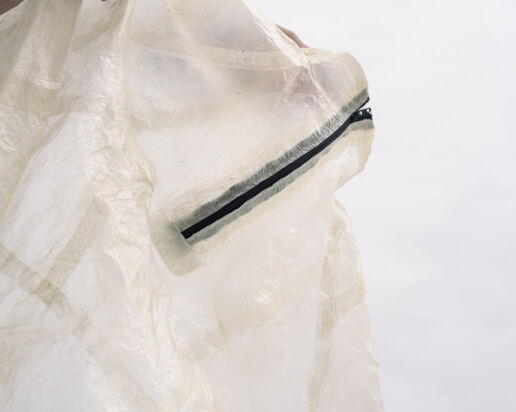
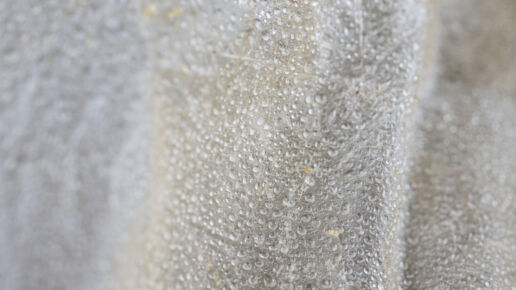
Animal skins, due to their properties, have been used by humans throughout history to create textiles with water-repellent capabilities. During a one-year research fellowship, WINT therefore investigated the aesthetic and functional design features of the skin of the goldbeater and sequenced the RNA. The goal: to synthetically replicate the material properties, develop a biopolymer and use it to make high- performance textiles. In cooperation with Mimotype
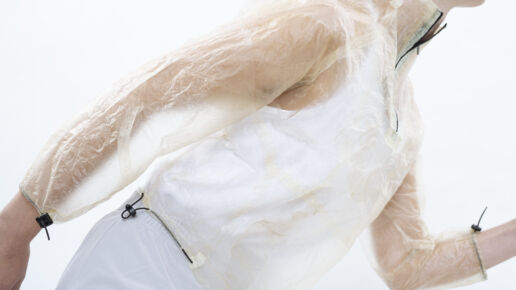
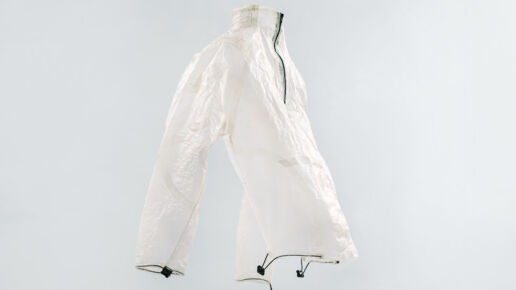
Technologies, a biotech start-up from Berlin, and funded by the BIOTEXFUTURE project of the ITA Institute of Textile Technology, the researchers succeeded in cultivating the unique material in bioreactors. The result is bio-synthetically grown collagen substrate – vegan and biodegradable – from which WINT has reated a running jacket that meets both aesthetic and functional demands.
While the global demand for synthetic textiles continues to rise and their production consumes large amounts of petrochemicals, energy and finite raw materials, a new generation of water-repellent outdoor jackets is thus born.
Source: GOLD
Source: GOLD
Source: GOLD
“As designers we have to shift the reasoning of our practice from convenience to impact.”
———————————————————————–
THIS MIGHT BE ALSO INTERESTING FOR YOU:
EMELIE SANDRE DESIGN – SUSTAINABLE INNOVATIONS
Modularity is hardly a new concept. It has transformed architecture, furniture and industrial design for decades. Applying it to soft textiles, however, opens an entirely different conversation.
Smart Textile Design – SUSTAINABLE INNOVATIONS
We have always been driven by creativity and curiosity. Our practice evolves through prototypes, never finished, always asking more questions of materials, processes and possibilities.
STUDIO ALICE GIELEN – SUSTAINABLE INNOVATIONS
It is an idea that feels increasingly relevant as artificial intelligence and computational design become part of fashion's creative landscape. Perhaps the future is not about humans versus machines. Perhaps it is about learning how to create together.