

SUSTAINABLE INNOVATIONS 2026:
Interview with Simon Angel, Curator of SUSTAINABLE INNOVATIONS
Guest article by Muchaneta ten Napel
Simon Angel has been curating the Sustainable Innovations Area at KEYHOUSE since 2018. For the January 2026 edition, Sustainable Innovations once again brings together projects that question, provoke, and expand the future of textiles. Register now to attend Sustainable Innovations at KEYHOUSE.
When you curate SUSTAINABLE INNOVATIONS, what tells you a project is genuinely worth platforming, beyond novelty or technical achievement?
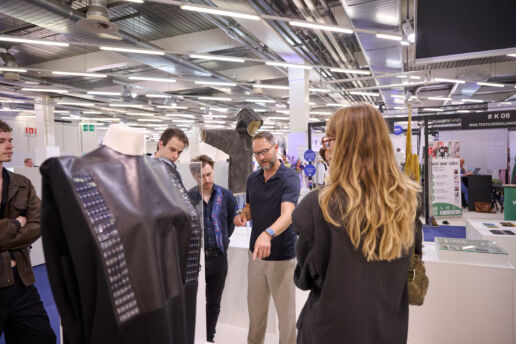
Simon Angel: For me, novelty by itself is never enough, I always search behind the curtains, looking for stories, paradoxes, pain, pleasure and purpose. Technical achievement is important, but it is only a starting point. What I look for is whether a project asks an honest question about how we live, make, and value. A project becomes worth platforming when it shows responsibility towards material, culture, and consequence. That responsibility can take many forms. In Marie Vilay’s work, it appears as care for knowledge, authorship, and continuity. In Materia Futura, it emerges as a refusal to accept that sustainability must look deprived or emotionally flat. In Threaded Protocols, it shows up as a quiet but powerful re-examination of how technology itself is constructed. What connects them is not perfection, but intention. They are not trying to impress the industry. They are trying to understand it, and sometimes to gently disturb it; reframing or disrupt the ‘pattern’ of the industry. That is where I feel Sustainable Innovations has its real value.
Many of the projects you select are not market-ready products. Why is it important, in your view, for an industry-focused fair to make space for unfinished or exploratory work?
Simon Angel: Because the future does not arrive fully packaged. If we only show what is ready for market, we only ever validate what already fits existing systems. Sustainable Innovations exists precisely to create space for what does not yet fit. Exploratory work allows us to see where thinking is moving before it becomes constrained by commercial frameworks. It is therefore an invitation to explore and to inspire. Projects like Materia Futura or Threaded Protocols are not trying to sell a product. They are offering a shift in perception. They allow the industry to engage with material, technology, and responsibility at a conceptual level before those ideas harden into supply chains and price points. An industry that only looks at finished solutions risks losing its ability to imagine better ones.
Looking at this year’s exhibitors, what do you feel they have in common?
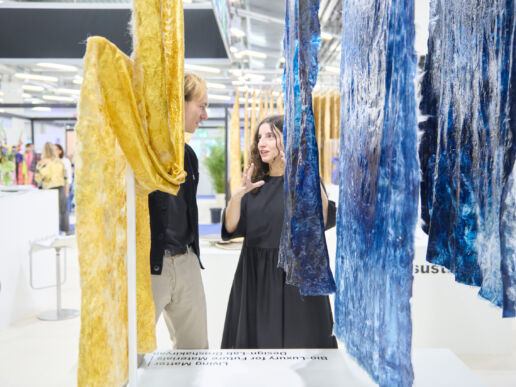
Simon Angel: What they share is a deep awareness that textiles are not neutral. Whether it is Marie Vilay questioning how textile knowledge travels across cultures or Materia Futura reclaiming sensory desire in bio-based materials, each project understands textiles as carriers of history, power, emotion, and choice. They are not interested in materials as surfaces alone. They are interested in materials as systems of meaning. And importantly, none of them treats sustainability as a technical checklist. They treat it as a cultural responsibility. Textile with layers of different understandings, functions and conscious.
Many innovations struggle at the point of scale. What responsibility, if any, do curators and platforms have in addressing that gap?
Simon Angel: We cannot solve scale for innovators, but we can change how scale is understood. Too often, scale is presented as the only measure of success. But some projects are not meant to scale in the conventional sense. Their value lies in how they influence thinking, education, or future processes. As curators, our responsibility is to provide context. To connect exploratory work with industry actors who can interpret, adapt, or carry those ideas forward responsibly. To prevent innovation from being consumed only as trend material. Scale should be a conversation, a question mark maybe, but not a demand.
Across the projects this season, what assumptions about textiles or fashion do you think the industry most needs to unlearn?
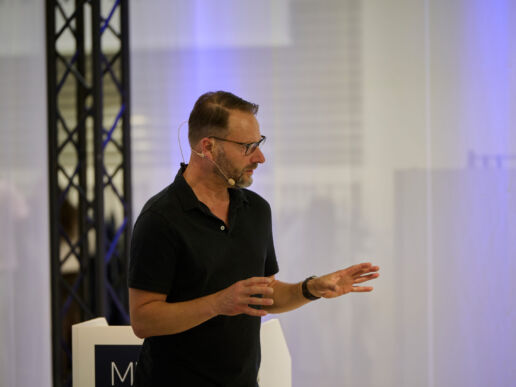
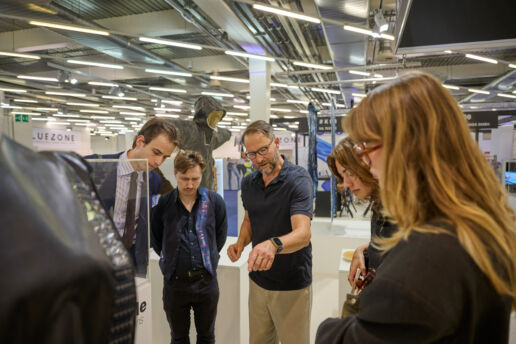
Simon Angel: That sustainability must look modest, technical, or restrained. That innovation must be fast. That materials are separate from culture. That efficiency is always progress. The projects being presented should remind us that desire is not the enemy of sustainability. The industry must unlearn the idea that responsibility is a limitation. It is, in fact, a creative force.
If the wider industry took just one lesson from this year’s SUSTAINABLE INNOVATIONS, what would you want it to be?
Simon Angel: That innovation is not only about what we make, but about how we choose to make meaning. Sustainable Innovations is not a showroom of answers. It is an invitation to think differently. To slow down. To notice. To question. To reconnect material with intention. If the industry leaves with a renewed sense of responsibility towards both material and imagination, then the platform is doing its job.

About the author
Founding editor-in-chief of Shape Innovate, Muchaneta has worked in the fashion industry for over 14 years. She is currently one of the leading influencers speaking and writing about the merger of fashion with technology and wearable technology.
Muchaneta ten Napel | m@shapeinnovate.com
THIS MIGHT BE ALSO INTERESTING FOR YOU:
EMELIE SANDRE DESIGN – SUSTAINABLE INNOVATIONS
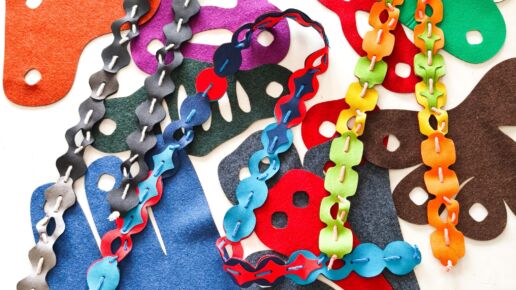
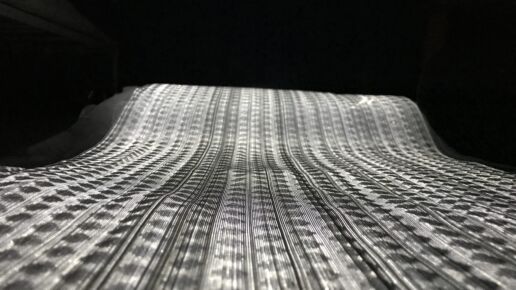
Modularity is hardly a new concept. It has transformed architecture, furniture and industrial design for decades. Applying it to soft textiles, however, opens an entirely different conversation.
Smart Textile Design – SUSTAINABLE INNOVATIONS
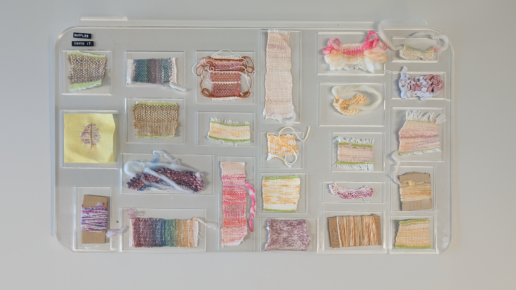
We have always been driven by creativity and curiosity. Our practice evolves through prototypes, never finished, always asking more questions of materials, processes and possibilities.
STUDIO ALICE GIELEN – SUSTAINABLE INNOVATIONS
It is an idea that feels increasingly relevant as artificial intelligence and computational design become part of fashion's creative landscape. Perhaps the future is not about humans versus machines. Perhaps it is about learning how to create together.

Leather from the Sea – SUSTAINABLE INNOVATIONS
"Through hands-on experimentation, I explore the potential of new surfaces and alternative forms of leather, aiming to reconnect human life with the natural world as an interconnected fabric."
Maison du Flock – SUSTAINABLE INNOVATIONS
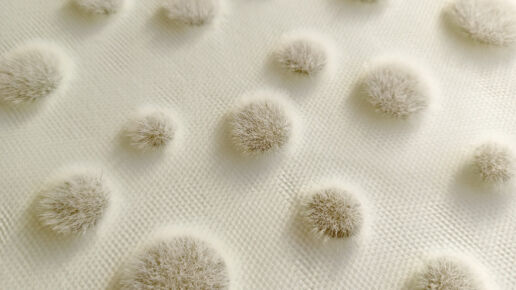
Working with everything from delicate tulle and lace to leather, sequins and other unconventional materials, the studio has transformed flock into a contemporary design language capable of meeting the demands of luxury fashion and Haute Couture.

MUNICH FABRIC START – January 26 closing report
A solid trade show. An optimistic mindset. That sums up the outcome of MUNICH FABRIC START. After three days, the Munich textile fair came to an end yesterday, Thursday, with the integrated show-in-shows BLUEZONE, KEYHOUSE and THE SOURCE. MUNICH FABRIC START concluded with a stable visitor frequency compared to the previous event.
MUNICH FABRIC START – Between Attitude and Sensuality
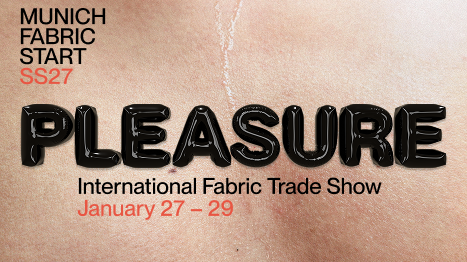
The future begins where we reimagine it. The overarching theme of PLEASURE stands for fashion as an emotional space, as an expression of attitude and cultural reflection.

KnitForm+ by Jeanne Mora – SUSTAINABLE INNOVATIONS
What matters is how the textile responds: how it regulates volume, distributes pressure, and transitions from flat to three-dimensional states. Process transparency is embedded in the methodology itself.

Cartoon – WEAR YOUR OPTIMISM
Embark on this fashionable journey and discover the new Cartoon collection at our store. Be inspired, mix and match to your heart's content, and wear optimism—every day, for every occasion.

RETRAKT – SUSTAINABLE INNOVATIONS
Performance, in this context, is measured by organisational resilience. RETRAKT applies resilience engineering to help employees anticipate, monitor, respond to, and learn from complex and changing requirements.