

Fashion made from next-gen materials
In conversation with Ganni about their sustainability journey
Interview by Muchaneta ten Napel, Founder and CEO, Shape Innovate
Munique magazine contributor Muchaneta ten Napel, recently had the opportunity to sit down with Lauren Bartley, the Chief Sustainability Officer at GANNI to dive into the brand’s sustainable initiatives and vision for the future of fashion.
Muchaneta ten Napel (MTN): “Lauren, can you share with us GANNI’s journey towards sustainability and how it’s integrated into your brand’s ethos and fashion design?”
Lauren Bartley (LB): “Absolutely, Muchaneta. It starts with our founders Ditte and Nicolaj, who are personally passionate about the topic of sustainability and hacking the fashion system – it’s at the core of everything we do at GANNI and has been key to our progress in the area. In 2019, we created our first sustainability strategy the GANNI Game-plan comprised of 44+ goals to reach by 2023 surrounding People, Planet, Product and Prosperity. In 2022, we completed our first strategy and became a B Corp Certified company and now we are well in to our second strategy Game-plan 2.0, running until 2025 – which creates further impact to our business model and operations.”
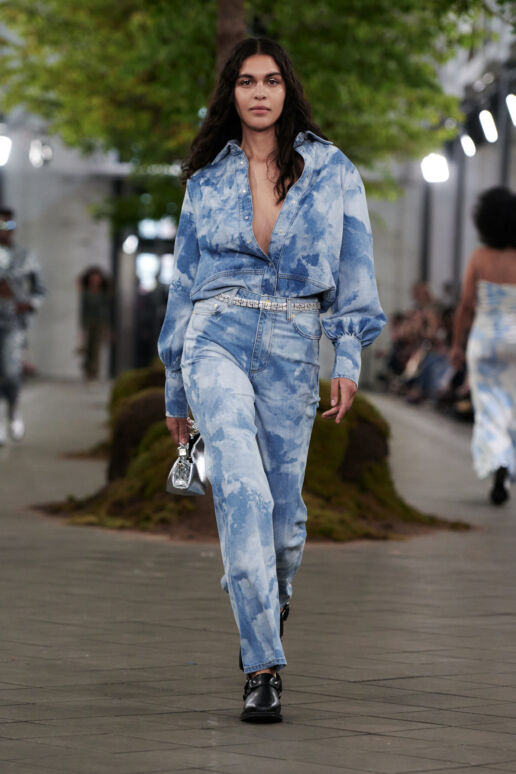
Future Denim Shirt med in Circulose® by Renewcell – a natural material made via textile waste, and Circulose®, which transforms textile waste into a new material without the need for cotton fields, oil, or trees
Our GANNI Bou bag in Ohoskin, made from orange and catus 100% Ohoskin (48% plant-based content, 52% Recycled Plastics)
Photo by Mathias Nordgreen
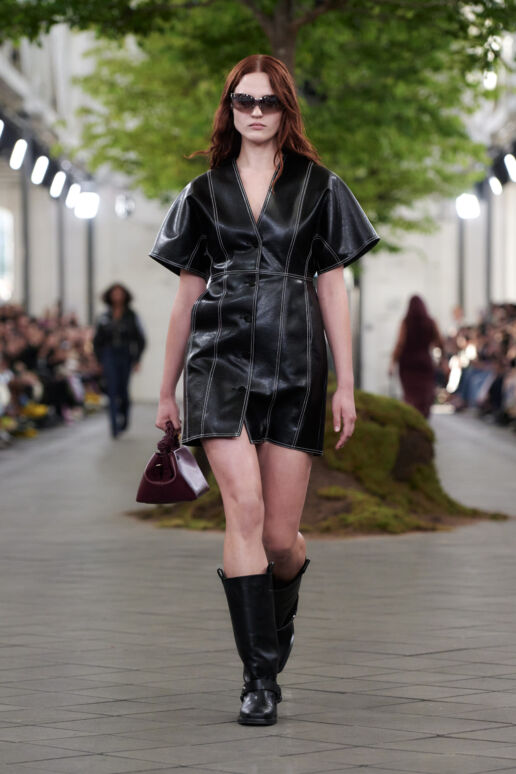
Dress in Oleatex – a plant-based olive leather alternative made from waste streams from olive oil production.
Our GANNI Bou bag in Ohoskin, made from orange and catus 100% Ohoskin (48% plant-based content, 52% Recycled Plastics)
Photo by Mathias Nordgreen
M.T.N.: “What are the unique challenges and opportunities you’ve encountered in incorporating next-generation materials into GANNI’s collections?”
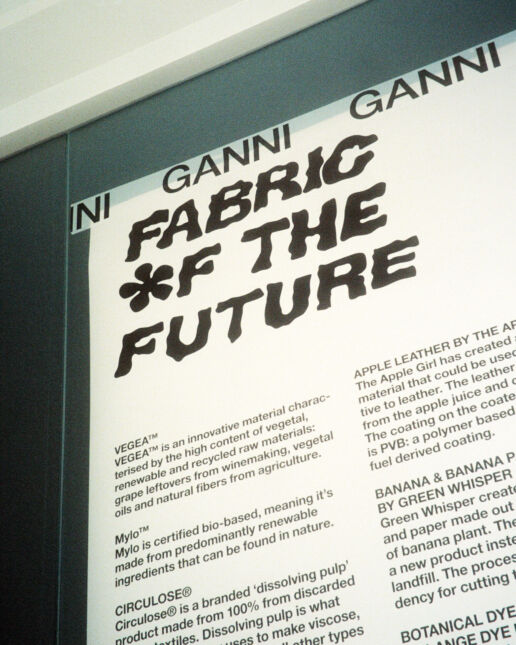
L.B.: “The opportunity is to re-think fashion as we know it and empower our designers to do what they do best – get creative – and create something beautiful. We’re committed to working with fabric innovation as it’s the only way we will reach our ambitious carbon reduction goals – a 50% absolute carbon reduction by 2027. By 2025, 10% of our collections will be made from Fabrics of the Future. There are obviously challenges too, especially around scalability and the commerciality of the materials and that’s why it’s so important for us to invest and encourage other brands to invest too, because we all desperately need the solutions the innovators are offering. Commercial viability, but it’s essential to invest in these innovations.”
M.T.N.: “How has GANNI’s experience been in piloting new textiles on a smaller scale, and what impact has community feedback had on these initiatives?”
L.B.: “We will always introduce a new fabric innovation through a pilot project, to test and learn and get feedback from our community. So far, the response has been extremely positive. For us it’s about seeing these next-gen materials as something new and not comparing it to existing materials and fabrications.”
M.T.N.: “Navigating the costs and investments in sustainable materials is crucial. Can you discuss GANNI’s approach?”
L.B.: “Its early days, for now we have piloted around 10 material innovations, but the challenge is really to scale them to a commercially viable status. The pilots are an investment for GANNI, with no clear return on investment, that is not a sustainable model for any company and that is why we need these innovators to succeed and for GANNI to do whatever we can to help make it possible. We will have Renewcell’s Circulose in our main collections in 2024 and scaled and it’s exciting to see how that resonates with our community.”
M.T.N.: “Could you share insights into GANNI’s strategies for circular fashion and waste management?”
L.B.: “As part of our Game-plan 2.0 and commitment to Circularity, we have a goal of 5% of revenue coming from circular business models by 2025 from a 2021 baseline. With our Circular Business Models we look at new business models that have potential to reimagine the fashion industry as we know it. Currently, we are revising the Circularity strategy and will be sharing more on our goals within the pillars ‘Designed for Circularity’, ‘Recycling’ and ‘Circular Business Models’ in early 2024.”

M.T.N.: “How does GANNI approach consumer education regarding sustainable fashion?”
L.B.: “Our biggest communication channel on Responsibility is our instagram account @GANNI.Lab where 100% of the feed is dedicated to our journey in becoming the most responsible version of ourselves. This is very much about what GANNI needs to do and where we are on our journey and does not put the onus on the end consumer. With all our communication we try to speak to our community in a meaningful and honest, not perfect way, showing the hard stuff, the stuff we didn’t get right, as much as we show the stuff we nailed.”
M.T.N.: “In the context of forming partnerships, what insights can you share about GANNI’s collaborations?”
L.B.: “We believe in the power of industry collaboration, no brand will succeed in a sustainable transition alone. GANNI works with over 30 material innovators and 13 partners and software solutions to help us progress on environmental sustainability, social sustainability and traceability. We would not be where we are without our partners.”
M.T.N.: “As the Chief Sustainability Officer, what is your vision for the future of sustainable fashion?”
L.B.: “For me, the onus is on the brands to offer more sustainable solutions to its customers – whether that be more responsible fabrics, transparent supply chains, workers paid a living wage and the adoption of new business models such as resale. We cannot force people into sustainable fashion, but by making it convenient, accessible and raising the education and awareness of some of the challenges and ultimately solutions in the industry, we can encourage more responsible consumption and behaviour. It’s a brave endeavour for a brand to recognise their own shortcomings, but being transparent, being honest and not perfect solidifies the value and integrity of the company- which ultimately, we can all appreciate as consumers”.
Are you interested in more in-depth facts and figures on the new textile industry?
Visit the Shape Innovate Lounge in H5 | 04 or take part in the mini-lectures in the Keyhouse.

About the author
Muchaneta Ten Napel is the founder of Shape Innovate, a company that critically examines the economic impact of the fashion industry and publishes comprehensive, data-driven research, white papers and forecasts that shed light on the fiscal dynamics of both fast fashion and sustainable fashion practices.
In addition to running Shape Innovate, Muchaneta is the driving force behind FashNerd.com, her own digital platform dedicated to the latest tech developments in the fashion industry. As well as writing for her platform, she has also contributed to Vogue Business and is currently a senior contributor at The Interline.
Muchaneta is a lecturer at London College of Fashion (UAL), has taught at Conde Nast College of Fashion and UCL and has held a workshop at Zurich University of the Arts to share her extensive knowledge.
With extensive industry experience, Muchaneta is also a fashion innovation consultant and has authored in-depth research for companies such as LVMH Atelier.Muchaneta, who was actively involved with the UNFCC and Climate KIC during COP27, is now Chair of the Cultural and Creative Industries (CCI) Taskforce for the UN Climate Change Global Innovation Hub.
To further expand her influence, Muchaneta hosted the Innovation Stage at the Global Fashion Summit in Copenhagen and is a board member of the Fashion Innovation Center, where she contributes her strategic insights to further revolutionise the industry.
Muchaneta ten Napel | m@shapeinnovate.com
This might be also interesting for you:
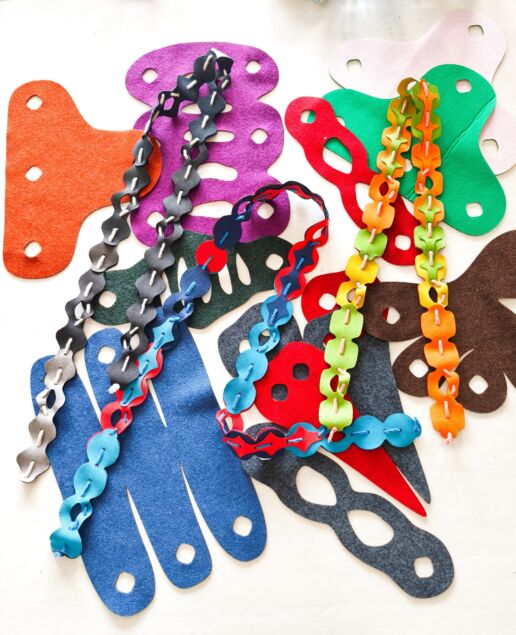
EMELIE SANDRE DESIGN – SUSTAINABLE INNOVATIONS
Modularity is hardly a new concept. It has transformed architecture, furniture and industrial design for decades. Applying it to soft textiles, however, opens an entirely different conversation.
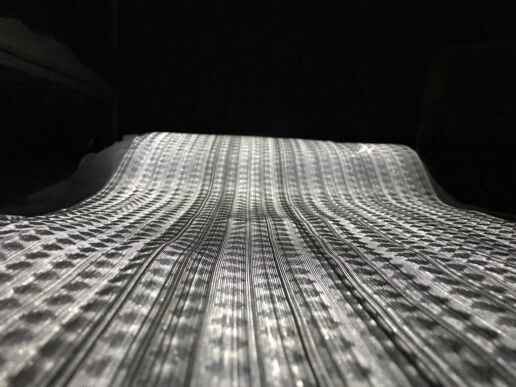
Smart Textile Design – SUSTAINABLE INNOVATIONS
We have always been driven by creativity and curiosity. Our practice evolves through prototypes, never finished, always asking more questions of materials, processes and possibilities.
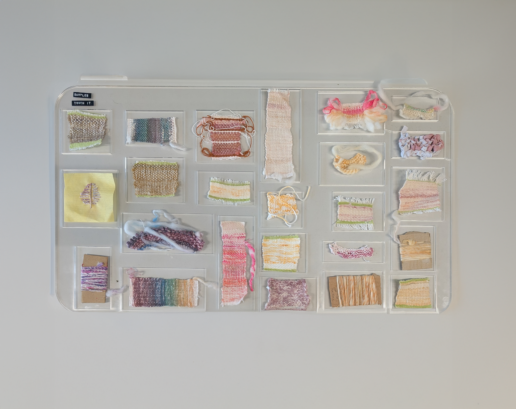
STUDIO ALICE GIELEN – SUSTAINABLE INNOVATIONS
It is an idea that feels increasingly relevant as artificial intelligence and computational design become part of fashion's creative landscape. Perhaps the future is not about humans versus machines. Perhaps it is about learning how to create together.
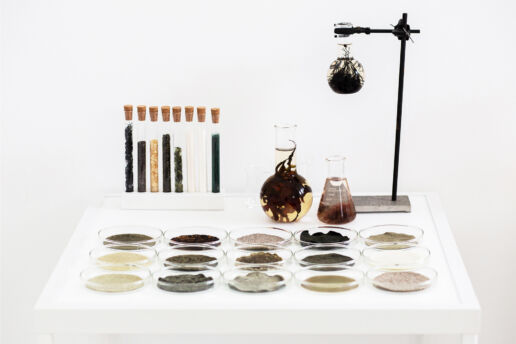
Leather from the Sea – SUSTAINABLE INNOVATIONS
"Through hands-on experimentation, I explore the potential of new surfaces and alternative forms of leather, aiming to reconnect human life with the natural world as an interconnected fabric."
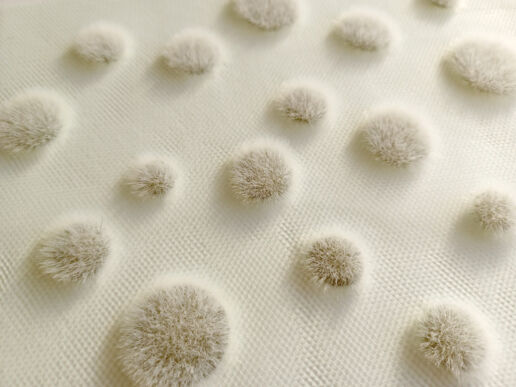
Maison du Flock – SUSTAINABLE INNOVATIONS
Working with everything from delicate tulle and lace to leather, sequins and other unconventional materials, the studio has transformed flock into a contemporary design language capable of meeting the demands of luxury fashion and Haute Couture.

MUNICH FABRIC START – January 26 closing report
A solid trade show. An optimistic mindset. That sums up the outcome of MUNICH FABRIC START. After three days, the Munich textile fair came to an end yesterday, Thursday, with the integrated show-in-shows BLUEZONE, KEYHOUSE and THE SOURCE. MUNICH FABRIC START concluded with a stable visitor frequency compared to the previous event.
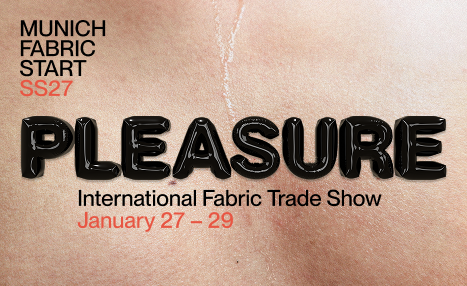
MUNICH FABRIC START – Between Attitude and Sensuality
The future begins where we reimagine it. The overarching theme of PLEASURE stands for fashion as an emotional space, as an expression of attitude and cultural reflection.
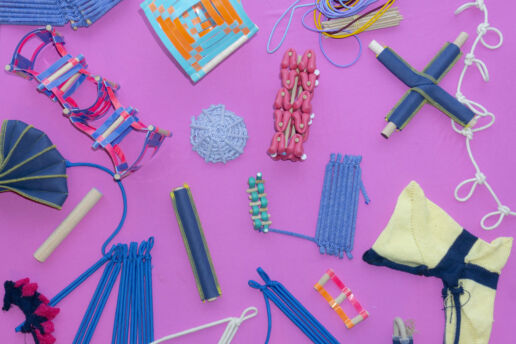
KnitForm+ by Jeanne Mora – SUSTAINABLE INNOVATIONS
What matters is how the textile responds: how it regulates volume, distributes pressure, and transitions from flat to three-dimensional states. Process transparency is embedded in the methodology itself.

Cartoon – WEAR YOUR OPTIMISM
Embark on this fashionable journey and discover the new Cartoon collection at our store. Be inspired, mix and match to your heart's content, and wear optimism—every day, for every occasion.

RETRAKT – SUSTAINABLE INNOVATIONS
Performance, in this context, is measured by organisational resilience. RETRAKT applies resilience engineering to help employees anticipate, monitor, respond to, and learn from complex and changing requirements.