

KEYHOUSE – The Innovation Hub For Tomorrow's Fashion
Working towards a scalable solution for textile-to textile recycling: Introducing the T-REX Project
In the atmospheric industrial charm of KEYHOUSE, Hall 7, progressive suppliers and global players from cross-industry sectors will be showcasing their latest new developments and innovations. On over 1,000 square metres, you will find trend-setting future fabrics and new process technologies – be it in terms of sustainability, circular economy, digitalisation & AI, traceability, textile dyeing or finishing. Staged as an interactive think tank, future-oriented show cases will be in the spotlight alongside sustainable innovations.
KEYHOUSE is also home to the main lecture forum of MUNICH FABRIC START with exclusive keynotes, panel discussions, trend presentations, Q&A sessions & expert talks by international industry insiders. Be inspired by the wide range of events at KEYHOUSE.
Working towards a scalable solution for textile-to textile recycling: Introducing the T-REX Project
Today, only 2% of post-consumer textiles in the EU are diverted to fibre-to-fibre recycling. The T-REX (Textile Recycling Excellence) Project brings together 13 major players from the textile industry along with research institutions to create a harmonised EU blueprint for closed loop sorting, and recycling of household textile waste.


Drishti Masand, Senior Manager, Sustainability Direction – adidas
Across a three-year period, the EU-funded T-REX Project l is working to collect and sort household textile waste and demonstrate the full recycling process of polyester, polyamide 6, and cellulosic materials from textile waste into new garments.
“Circularity is a team sport, and we need to play together to win – this is the ethos of the circularity work at adidas. By bringing together major players across the whole value chain, the T-REX Project aims to demonstrate a new ecosystem approach, with harmonised methods and quality criteria.” – Drishti Masand
The project ultimately aims to develop systemic solutions to the problem of textile waste by identifying the infrastructure, technology, and policy needed to encourage the growth of circular value chains in the textile industry. At the same time, the consortium will also work on assessing how citizens can be empowered to actively contribute to the transition towards a circular textiles system.
“Currently, innovative materials like textile-to-textile recycled fibres constitute less than 1% of the fibre mix. A combination of brand commitment, legislation, and regulation can accelerate the adoption of next-gen materials.” – Jyotsna Gopinath

Jyotsna Gopinath, Innovation Analyst – Fashion for Good
Drishti Masand, Senior Manager, Sustainability Direction at adidas, and Jyotsna Gopinath, Innovation Analyst at Fashion for Good, will delve into the insights and learnings garnered from the project so far in an upcoming talk and panel discussion within the KEYHOUSE area programme, moderated by Muchaneta ten Napel.
Join the “IN CONVERSATION WITH Drishti Masand” session on Tuesday, 3rd September at 11am
&
Don’t miss to be part of the Panel Discussion on “Closing the Loop: Breaking Down Barriers in Fiber Recycling for Fashion” on Wednesday, 4th September at 3pm
TREND LECTURES | KEYHOUSE – Hall 7

Muchaneta ten Napel, Founder & CEO – Shape Innovate

THIS MIGHT BE ALSO INTERESTING FOR YOU

MUNICH FABRIC START – January 26 closing report
A solid trade show. An optimistic mindset. That sums up the outcome of MUNICH FABRIC START. After three days, the Munich textile fair came to an end yesterday, Thursday, with the integrated show-in-shows BLUEZONE, KEYHOUSE and THE SOURCE. MUNICH FABRIC START concluded with a stable visitor frequency compared to the previous event.
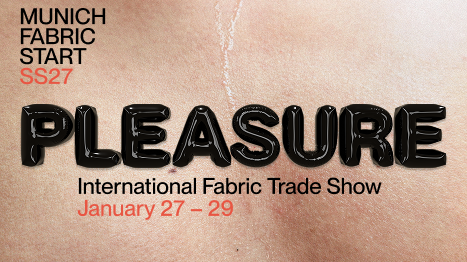
MUNICH FABRIC START – Between Attitude and Sensuality
The future begins where we reimagine it. The overarching theme of PLEASURE stands for fashion as an emotional space, as an expression of attitude and cultural reflection.

KnitForm+ by Jeanne Mora – SUSTAINABLE INNOVATIONS
What matters is how the textile responds: how it regulates volume, distributes pressure, and transitions from flat to three-dimensional states. Process transparency is embedded in the methodology itself.

Cartoon – WEAR YOUR OPTIMISM
Embark on this fashionable journey and discover the new Cartoon collection at our store. Be inspired, mix and match to your heart's content, and wear optimism—every day, for every occasion.

RETRAKT – SUSTAINABLE INNOVATIONS
Performance, in this context, is measured by organisational resilience. RETRAKT applies resilience engineering to help employees anticipate, monitor, respond to, and learn from complex and changing requirements.

MATERIA FUTURA – SUSTAINABLE INNOVATIONS
Materia Futura is not proposing a new bio-material category, nor a finished commercial textile. What distinguishes the project is its design-led investigation into the emotional and aesthetic dimensions of bio-based materials, an area often sidelined in sustainability discourse.
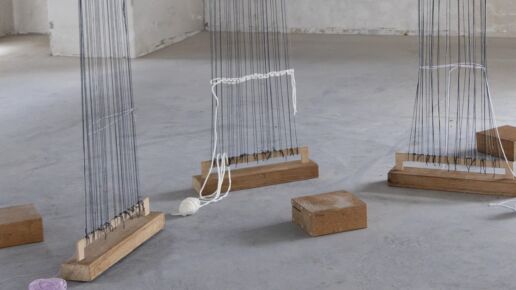
THREADED PROTOCOLS – SUSTAINABLE INNOVATIONS
Threaded Protocols is not a textile innovation in the commercial sense, nor a digital tool disguised as craft. What makes the work distinct is its material investigation into how computational logic originates in textile practice and what is lost when those logics are abstracted into opaque technological systems.
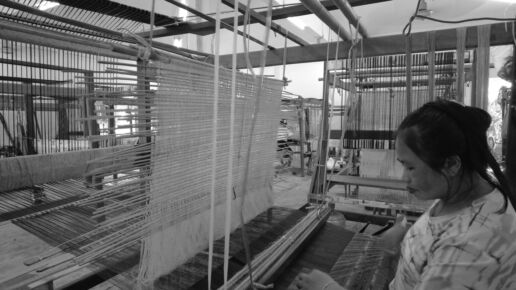
MARIE VILAY – SUSTAINABLE INNOVATIONS
Marie Vilay does not present a new fabric or production technique. What distinguishes her work is a method of reading and translating textile knowledge across cultures, systems, and moments of transition.
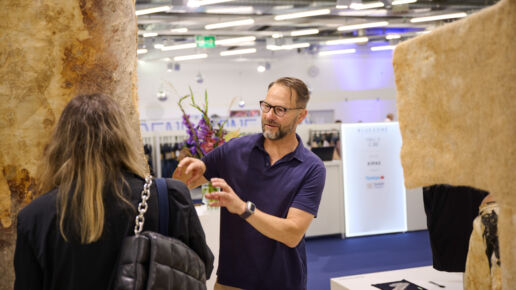
Interview with Simon Angel, Curator of SUSTAINABLE INNOVATIONS
Each season, the Sustainable Innovations forum brings together projects that provoke, inspire, and challenge assumptions. This year is no exception, with work ranging from bio-luxury couture to energy-generating textiles and regenerative materials grown from wetlands.
MUNICH FABRIC START – September 25 closing report
At its 56th edition, MUNICH FABRIC START reinforced its clear positioning. Over two days, the Munich textile trade show brought the fashion industry together with its four show-in-show formats.