

FABRICS NEWS
New Collection by PAULO DE OLIVEIRA
Discover the new Spring/Summer 2026 Collection by Paulo de Oliveira
Founded in 1936, in Covilhã, Portugal, Paulo de Oliveira, SA, is a leader in the production of elastic fabrics in Europe and exports most of its production to all continents. They are a vertical company producing from fiber to fabric, under the same roof, including the spinning, weaving, dyeing and finishing for woven and knitting fabrics.
They are also a reference in sustainable production, with focus on sustainable raw materials produced in Europe with ecological processes, using recycled materials and renewable energy. Their manufacturing process is one of the most efficient in the world in terms of low carbon footprint. They keep on investing in the latest technology, being a state-of-the art unit for the production of wool fabrics and a reference company in the sector, globally.
PAULO DE OLIVEIRA group is composed of 3 textile companies: PAULO DE OLIVEIRA, PENTEADORA and TESSIMAX. The company has several certifications:
- STeP Certification by Oeko-Tex; Amfori Certification BSCI; GRS – Global
- Recycle Standard; RWS – Responsible Wool standard and Oeko-Tex Standard 100.
- They are registered in the BCI (Better Cotton Iniciative) platform – They are not members but they can buy BCI cotton and pass the credits of this cotton to the clients who want BCI cotton;
- They are registered in the ZDHC platform and they have the Supplier To Zero (Foundational Level) certification;
- They are registered in the Higg Index platform and they have the certificate of completion of the self-assessment of the environmental module (not verified).
With sustainability and responsibility guiding their practices, as previously mentioned, several investments were made:
New Biomass Boiler, allowing a reduction of carbon emissions (more than 3500 Tons of CO2/year avoided, meaning a 75% reduction);
Over 1.6 million invested on photovoltaic panels, allowing a reduction of electricity consumption from the grid and consequent reduction of indirect CO2 emissions associated with the production of this electricity;
As for wastewater recover and reuse, more than 1.4 million were invested in a wastewater recovery plant. They have their own Wastewater Treatment Plant (WWTP), since 2002 and 100% reuse of all incoming water, which is primarily used for cooling equipment.


“Their manufacturing process is one of the most efficient in the world in terms of low carbon footprint. They keep on investing in the latest technology, being a state-of-the art unit for the production of wool fabrics and a reference company in the sector, globally.”
They have undergoing an investment project to recover 65% of the treated effluent developed in the R&D Project jointly with University of Beira Interior, UBI. With this same institution (UBI), there’s a research project aiming the development of new effluent treatment processes for less pollutant load effluents. Adding to this, they proceeded with installing several flowmeters to improve the characterization and control of water consumption from different production processes. By implementing all of these measures, there was a drastic reduction of fresh water consumption and needs.
Because innovation is part of their DNA, new investments were made in spinning and weaving departments, in order to achieve even more sustainable products.
Now, regarding Paulo de Oliveira’s SS26 Collection, the focus remains on Sustainability, strengthening the Oliveira Green segment. Linen mixes, new designs, micro-designs and a variety of colors can be found, from pastel to the classics, we are bringing variety and innovation to the table, keeping up with the trends, with our high quality fabrics.


Visit them to discover their new collection and services presented at
Munich Fabric Start at Hall 3, Booth D20.
THIS MIGHT BE ALSO INTERESTING FOR YOU

MUNICH FABRIC START – January 26 closing report
A solid trade show. An optimistic mindset. That sums up the outcome of MUNICH FABRIC START. After three days, the Munich textile fair came to an end yesterday, Thursday, with the integrated show-in-shows BLUEZONE, KEYHOUSE and THE SOURCE. MUNICH FABRIC START concluded with a stable visitor frequency compared to the previous event.
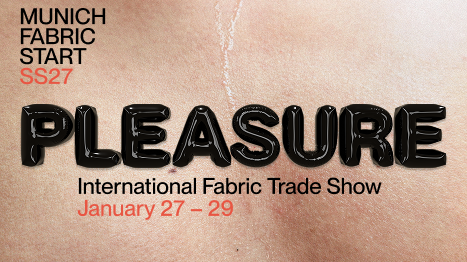
MUNICH FABRIC START – Between Attitude and Sensuality
The future begins where we reimagine it. The overarching theme of PLEASURE stands for fashion as an emotional space, as an expression of attitude and cultural reflection.

KnitForm+ by Jeanne Mora – SUSTAINABLE INNOVATIONS
What matters is how the textile responds: how it regulates volume, distributes pressure, and transitions from flat to three-dimensional states. Process transparency is embedded in the methodology itself.

Cartoon – WEAR YOUR OPTIMISM
Embark on this fashionable journey and discover the new Cartoon collection at our store. Be inspired, mix and match to your heart's content, and wear optimism—every day, for every occasion.

RETRAKT – SUSTAINABLE INNOVATIONS
Performance, in this context, is measured by organisational resilience. RETRAKT applies resilience engineering to help employees anticipate, monitor, respond to, and learn from complex and changing requirements.

MATERIA FUTURA – SUSTAINABLE INNOVATIONS
Materia Futura is not proposing a new bio-material category, nor a finished commercial textile. What distinguishes the project is its design-led investigation into the emotional and aesthetic dimensions of bio-based materials, an area often sidelined in sustainability discourse.
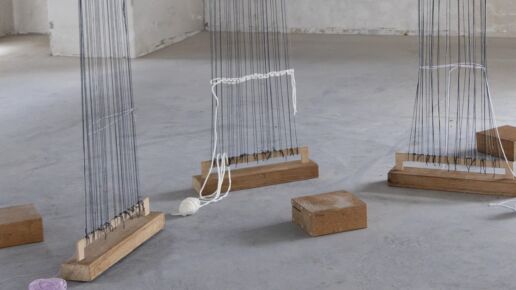
THREADED PROTOCOLS – SUSTAINABLE INNOVATIONS
Threaded Protocols is not a textile innovation in the commercial sense, nor a digital tool disguised as craft. What makes the work distinct is its material investigation into how computational logic originates in textile practice and what is lost when those logics are abstracted into opaque technological systems.
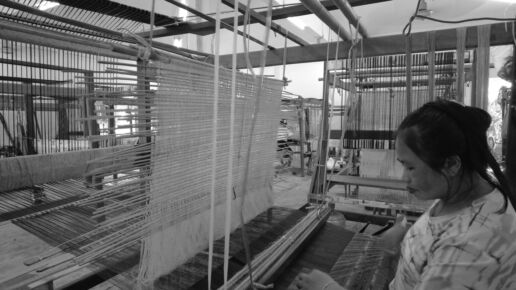
MARIE VILAY – SUSTAINABLE INNOVATIONS
Marie Vilay does not present a new fabric or production technique. What distinguishes her work is a method of reading and translating textile knowledge across cultures, systems, and moments of transition.
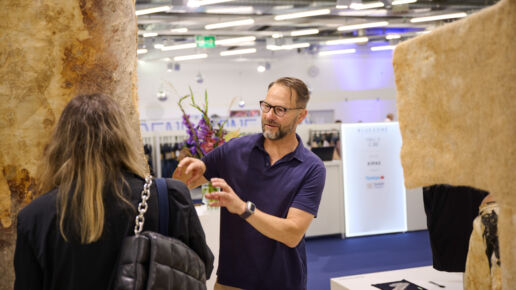
Interview with Simon Angel, Curator of SUSTAINABLE INNOVATIONS
Each season, the Sustainable Innovations forum brings together projects that provoke, inspire, and challenge assumptions. This year is no exception, with work ranging from bio-luxury couture to energy-generating textiles and regenerative materials grown from wetlands.
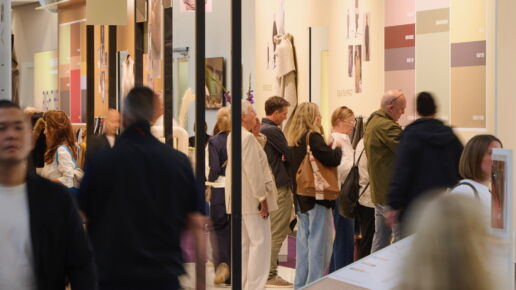
MUNICH FABRIC START – September 25 closing report
At its 56th edition, MUNICH FABRIC START reinforced its clear positioning. Over two days, the Munich textile trade show brought the fashion industry together with its four show-in-show formats.