

Partnering for a Greener Future:
How Collaboration Drives Sustainability in Fashion Textile Industry
Guest post by Muchaneta ten Napel, Founder and CEO, Shape Innovate

A contribution of Muchaneta ten Napel, the founder of Shape Innovate, a company that critically examines the economic impact of the fashion industry and publishes comprehensive, data-driven research, white papers and forecasts that shed light on the fiscal dynamics of both fast fashion and sustainable fashion practices.
In recent years, the textile and fashion industry has faced increasing pressure to adopt sustainable practices. As one of the largest polluters, the industry has a significant role to play in addressing environmental challenges. One of the most effective strategies to drive this change is through collaboration. By working together, companies can pool resources, share expertise, and innovate more effectively than they could alone.
The Importance of Collaboration
When it comes to the importance of collaboration, here are a few examples that clearly demonstrate how collaboration is crucial in driving sustainable innovation within the textile and fashion industry. By working together, companies are able to share expertise and resources, leveraging each other’s strengths in design, technology, or sustainability practices. This pooling of resources not only accelerates the development and implementation of sustainable solutions but also drives innovation. Partnerships between diverse organisations foster creative problem-solving and can result in the development of groundbreaking technologies that might not have been possible through independent efforts.
Moreover, collaborative initiatives often have a broader reach and greater impact than efforts undertaken by single entities. By joining forces, companies can significantly influence industry standards and practices. Additionally, collaborations with reputable partners can enhance a company’s credibility and reputation in the eyes of consumers, stakeholders, and industry peers. By actively participating in collaborative sustainability projects, companies not only contribute to a culture of sustainability within the industry but also encourage others to follow suit, fostering a collective move towards more sustainable practices. Here, we explore the importance of collaboration in fostering sustainability and highlight five exemplary partnerships making a difference.
Adidas and the New Cotton Project with T-REX
Adidas has been at the forefront of sustainability initiatives, and its collaboration with the New Cotton Project and T-REX is a testament to this commitment. The New Cotton Project focuses on creating a circular system for textiles by transforming textile waste into new fibres. By integrating this project with T-REX, Adidas aims to produce high-quality, sustainable garments. This partnership exemplifies how combining resources and expertise can lead to groundbreaking innovations in sustainability.


H&M and the Global Change Award
H&M Foundation’s Global Change Award is a collaborative initiative that seeks to identify and support early-stage innovations that can accelerate the shift to a circular fashion industry. By collaborating with innovators, scientists, and entrepreneurs, H&M provides funding and mentorship to bring these ideas to market. This initiative highlights the power of collaboration in fostering a culture of sustainability within the fashion industry.
Levi’s and Fashion for Good
Levi Strauss & Co., a leader in denim fashion, partnered with Fashion for Good, a global initiative that aims to make fashion a force for good. Through this collaboration, Levi’s supports and invests in startups and technologies that promote sustainability. One successful project is their work with the company Natural Fiber Welding to develop a plastic-free, fully recyclable denim. This partnership illustrates how established brands can drive change by supporting innovative startups.


Nike and the Sustainable Apparel Coalition
Nike is a founding member of the Sustainable Apparel Coalition (SAC), a collaborative organisation that includes brands, retailers, suppliers, and NGOs. The SAC developed the Higg Index, a suite of tools that allows companies to measure their environmental and social impacts. By collaborating through the SAC, Nike and other members work towards common sustainability goals, leveraging shared knowledge and resources to drive industry-wide improvements.
Patagonia and Yulex
Patagonia, known for its environmental activism, partnered with Yulex, a company specializing in plant-based rubber. Together, they developed wetsuits made from Yulex‘s natural rubber, offering a sustainable alternative to traditional neoprene. This collaboration not only reduces reliance on petroleum-based materials but also supports sustainable agriculture, as Yulex sources its rubber from responsibly managed plantations.

Conclusion
As the textile and fashion industry continues to evolve, collaboration remains a key driver of sustainable progress. The partnerships highlighted above demonstrate how working together can lead to significant advancements in sustainability, ultimately benefiting both the environment and society. By fostering a spirit of collaboration, the industry can move towards a more sustainable future, ensuring that fashion remains both innovative and environmentally responsible.
Join Shape Innovate on stage at Munich Fabric Start
In an engaging “In Conversation with…” session featuring Drishti Masand, Senior Manager, Sustainability Direction at adidas. Drishti will delve into how adidas leverages innovation and public research projects such as the EU-funded T-REX Project. Such initiatives are industry-wide team collaborations that speak to our efforts, allowing us to learn from the best and share our learnings with partners, which ultimately propels the industry to become more circular. Don’t miss this opportunity to learn about the innovative steps adidas is taking towards a more sustainable future.
ADIDAS X SHAPE INNOVATE – IN CONVERSATION WITH DRISHTI MASAND:
DISCOVERING INNOVATIONS – ADIDAS’ JOURNEY WITH THE NEW COTTON PROJECT AND T-REX
TUESDAY, 3 SEPTEMBER 2024 FROM 11AM – 12PM
TREND LECTURES | KEYHOUSE – HALL 7
About the author
Founding editor-in-chief of Shape Innovate, Muchaneta has worked in the fashion industry for over 14 years. She is currently one of the leading influencers speaking and writing about the merger of fashion with technology and wearable technology.
Muchaneta ten Napel | m@shapeinnovate.com
VISIT SHAPE INNOVATE AT THE KEYHOUSE IN HALL 7 AT BOOTH K 00
THIS MIGHT BE ALSO INTERESTING FOR YOU

MUNICH FABRIC START – Between Attitude and Sensuality
The future begins where we reimagine it. The overarching theme of PLEASURE stands for fashion as an emotional space, as an expression of attitude and cultural reflection.

KnitForm+ by Jeanne Mora – SUSTAINABLE INNOVATIONS
What matters is how the textile responds: how it regulates volume, distributes pressure, and transitions from flat to three-dimensional states. Process transparency is embedded in the methodology itself.

Cartoon – WEAR YOUR OPTIMISM
Embark on this fashionable journey and discover the new Cartoon collection at our store. Be inspired, mix and match to your heart's content, and wear optimism—every day, for every occasion.

RETRAKT – SUSTAINABLE INNOVATIONS
Performance, in this context, is measured by organisational resilience. RETRAKT applies resilience engineering to help employees anticipate, monitor, respond to, and learn from complex and changing requirements.

MATERIA FUTURA – SUSTAINABLE INNOVATIONS
Materia Futura is not proposing a new bio-material category, nor a finished commercial textile. What distinguishes the project is its design-led investigation into the emotional and aesthetic dimensions of bio-based materials, an area often sidelined in sustainability discourse.

THREADED PROTOCOLS – SUSTAINABLE INNOVATIONS
Threaded Protocols is not a textile innovation in the commercial sense, nor a digital tool disguised as craft. What makes the work distinct is its material investigation into how computational logic originates in textile practice and what is lost when those logics are abstracted into opaque technological systems.
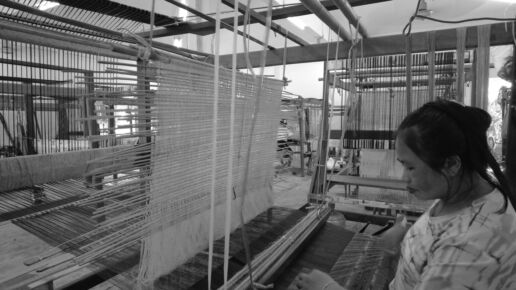
MARIE VILAY – SUSTAINABLE INNOVATIONS
Marie Vilay does not present a new fabric or production technique. What distinguishes her work is a method of reading and translating textile knowledge across cultures, systems, and moments of transition.
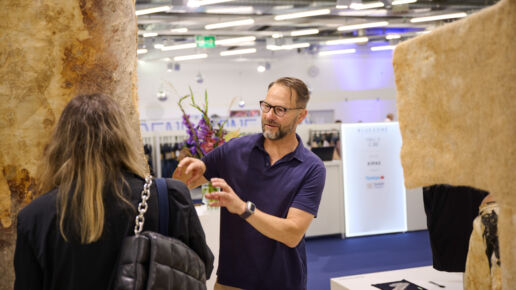
Interview with Simon Angel, Curator of SUSTAINABLE INNOVATIONS
Each season, the Sustainable Innovations forum brings together projects that provoke, inspire, and challenge assumptions. This year is no exception, with work ranging from bio-luxury couture to energy-generating textiles and regenerative materials grown from wetlands.
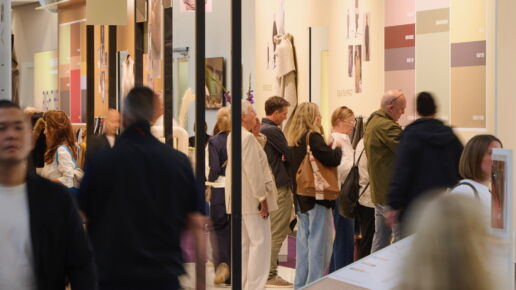
MUNICH FABRIC START – September 25 closing report
At its 56th edition, MUNICH FABRIC START reinforced its clear positioning. Over two days, the Munich textile trade show brought the fashion industry together with its four show-in-show formats.
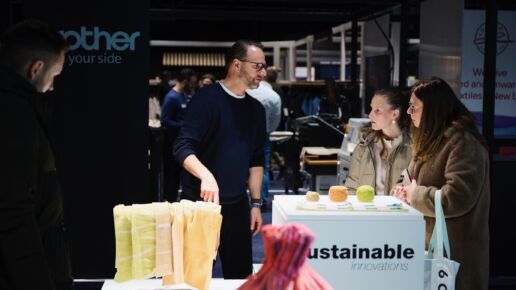
Materials as Agents of Change with Simon Angel
Each season, the Sustainable Innovations forum brings together projects that provoke, inspire, and challenge assumptions. This year is no exception, with work ranging from bio-luxury couture to energy-generating textiles and regenerative materials grown from wetlands.