

Textile Innovations:
Ready To Be Supercharged in 2023?
A contribution by Muchaneta ten Napel, Founder & CEO, Shape Innovate
Ready To Be Supercharged in 2023?
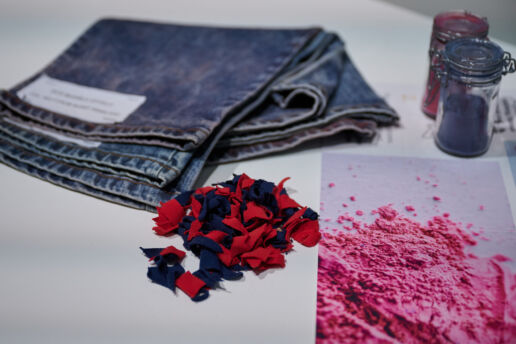
When it comes to textiles, one of the biggest challenges has been the industry taking on the responsibility to examine its processes. Although a necessary step, it is not an easy one for an industry built on foundations that date back to the mid-1700s industrial revolution. The good news is that with the help of new technology, the textiles industry is beginning to become better equipped to address most of the pain points in its supply chain, and in 2023 we may actually witness more innovations than ever being accelerated and scaled.
What To Expect in 2023
In the last few years, a shift in values has been redefining the textile industry. It is a shift driven by various technological solutions created to transform the global textile industry, so businesses can reach their sustainability and circularity goals and also understand the role that policy will most likely play in pushing value-driven fabrics forward.
So with innovation as its backbone, what can industry players seeking a more constructive view of the textile market expect in 2023?
Well, here is an overview of what is expected from the textiles space in 2023:
- There will be an acceleration and scaling of textile technologies that will position companies, small and midsize players, to explore further innovations that will help them align their business so they can adapt their practices and commit long-term.
- New fabrics will no longer survive but thrive as more research into sustainable materials and technologies increases and more brands continue to invest in sustainable and safer innovations.
- The textile industry in 2023 is expected to focus less on decadence and more on authenticity.
- We will witness the adoption of new business models that support sustainability initiatives — including supply chain traceability and the reduction of material usage.
- One of the growth drivers of the global textile market will be increasing demand for environmentally friendly and readily available natural fibres. In addition, more performance and technical fabrics will lean towards natural fibres.
- In 2023, more governments will start imposing stringent regulations. As a result, there will be more pressure on textile manufacturers to be less scattered and unorganised, especially when using toxic dyeing chemicals.
- The landscape will see an increase in market players whose USPs will be strongly driven by new technology and innovations. With a competitive edge, these material innovators bring new growth opportunities and strategies to the market.
- The textiles industry will continue to face materials, manufacturing and sustainability challenges in 2023. However, the good news is that the solutions that will continue to be explored in 2023 will be of a collaborative kind.
- Regarding future proofing manufacturing, 2023 strategies will push forward new research around new materials, digital manufacturing and sustainability for future textiles. In addition, textile manufacturers will create new supply chain models based on vertical integration, nearshoring, and small-batch production.
- In 2023, expect speed and agility to effectively tackle the challenges that slow down the growth of the textile and garment industry.
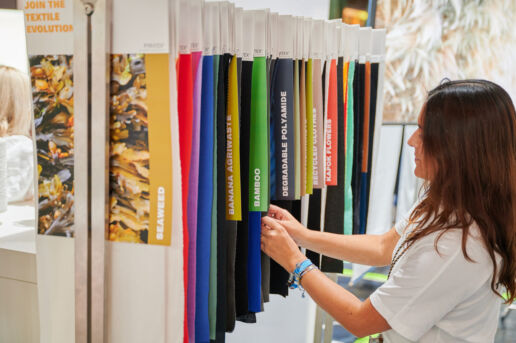
If you take away one thing, let it be this:
don’t be scared by the threat of new textile legislation distracted by the predicted digital shakedown or exhausted by the growing customer demands for sustainability.
Instead, ask yourself, if the future is promised to those who can ride through the challenges by embracing technology across their supply chain, can I afford to shy away from strategically sharpening my approach to the innovative dynamics driving the textile industry in 2023?
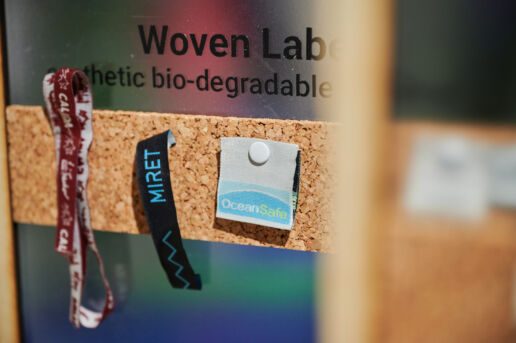
Are you interested in more in-depth facts and figures on the new textile economy?
Visit the Shape Innovate Lounge in H5 | 04 or attend the mini-lectures in the Keyhouse.
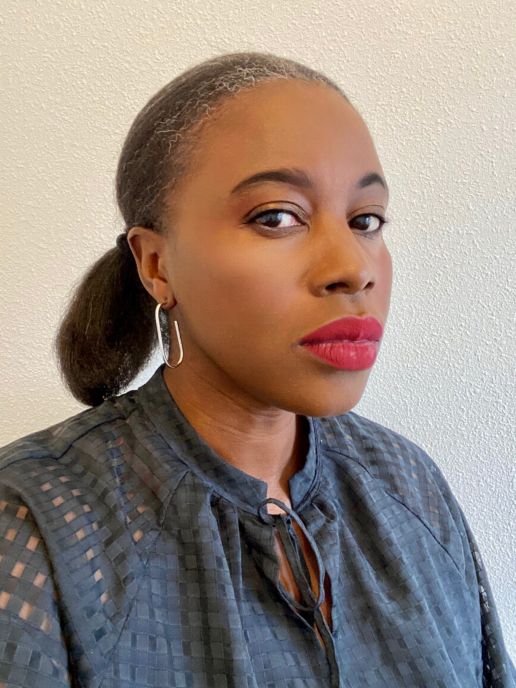
About the author
Founding editor-in-chief of Shape Innovate, Muchaneta has worked in the fashion industry for over 14 years. She is currently one of the leading influencers speaking and writing about the merger of fashion with technology and wearable technology.
Muchaneta ten Napel | m@shapeinnovate.com
This might be also interesting for you
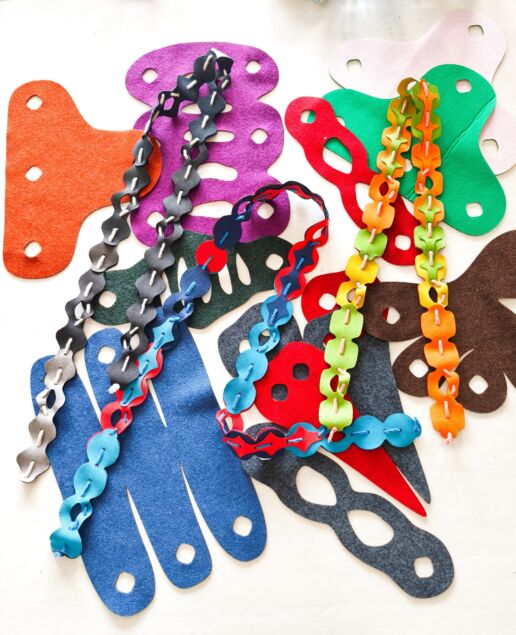
EMELIE SANDRE DESIGN – SUSTAINABLE INNOVATIONS
Modularity is hardly a new concept. It has transformed architecture, furniture and industrial design for decades. Applying it to soft textiles, however, opens an entirely different conversation.
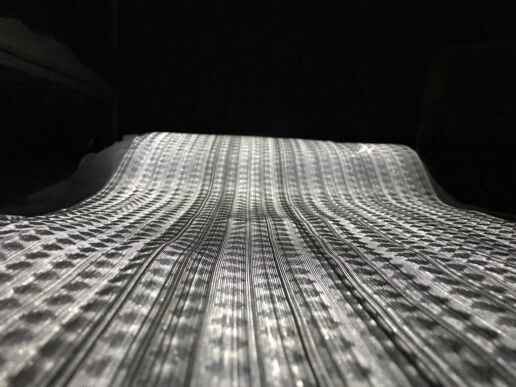
Smart Textile Design – SUSTAINABLE INNOVATIONS
We have always been driven by creativity and curiosity. Our practice evolves through prototypes, never finished, always asking more questions of materials, processes and possibilities.
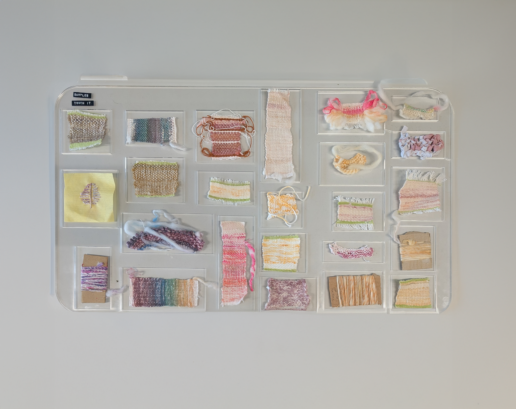
STUDIO ALICE GIELEN – SUSTAINABLE INNOVATIONS
It is an idea that feels increasingly relevant as artificial intelligence and computational design become part of fashion's creative landscape. Perhaps the future is not about humans versus machines. Perhaps it is about learning how to create together.

Leather from the Sea – SUSTAINABLE INNOVATIONS
"Through hands-on experimentation, I explore the potential of new surfaces and alternative forms of leather, aiming to reconnect human life with the natural world as an interconnected fabric."
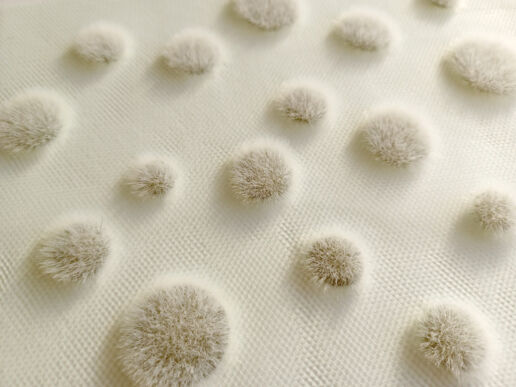
Maison du Flock – SUSTAINABLE INNOVATIONS
Working with everything from delicate tulle and lace to leather, sequins and other unconventional materials, the studio has transformed flock into a contemporary design language capable of meeting the demands of luxury fashion and Haute Couture.

MUNICH FABRIC START – January 26 closing report
A solid trade show. An optimistic mindset. That sums up the outcome of MUNICH FABRIC START. After three days, the Munich textile fair came to an end yesterday, Thursday, with the integrated show-in-shows BLUEZONE, KEYHOUSE and THE SOURCE. MUNICH FABRIC START concluded with a stable visitor frequency compared to the previous event.
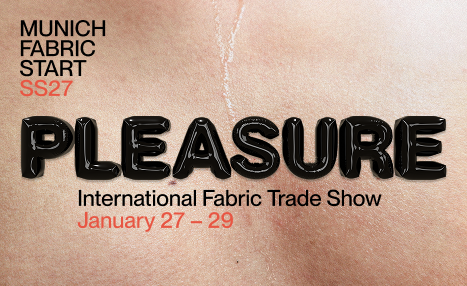
MUNICH FABRIC START – Between Attitude and Sensuality
The future begins where we reimagine it. The overarching theme of PLEASURE stands for fashion as an emotional space, as an expression of attitude and cultural reflection.
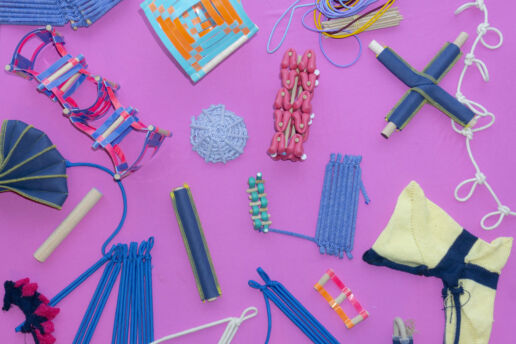
KnitForm+ by Jeanne Mora – SUSTAINABLE INNOVATIONS
What matters is how the textile responds: how it regulates volume, distributes pressure, and transitions from flat to three-dimensional states. Process transparency is embedded in the methodology itself.

Cartoon – WEAR YOUR OPTIMISM
Embark on this fashionable journey and discover the new Cartoon collection at our store. Be inspired, mix and match to your heart's content, and wear optimism—every day, for every occasion.

RETRAKT – SUSTAINABLE INNOVATIONS
Performance, in this context, is measured by organisational resilience. RETRAKT applies resilience engineering to help employees anticipate, monitor, respond to, and learn from complex and changing requirements.